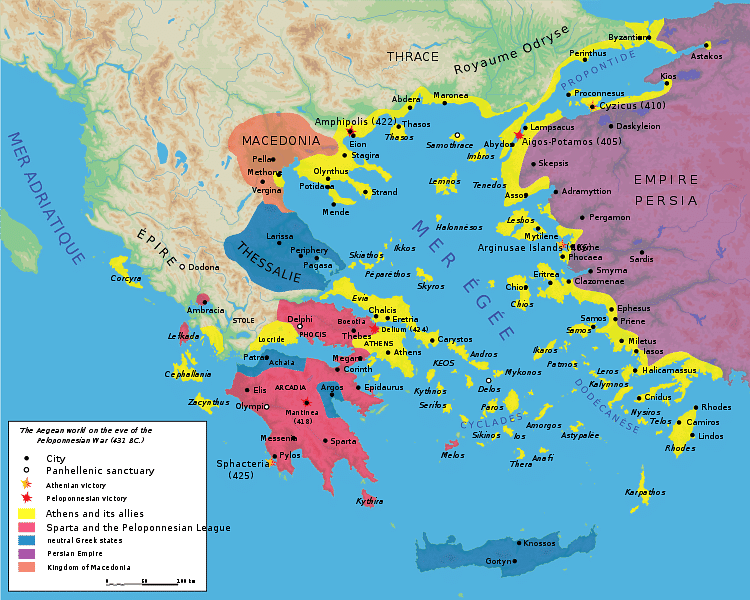
In ancient Greece, the empire was divided up into multiple city-states. Two of these powerful city-states were Athens and Sparta. But when two different groups rise to power, it is nearly inevitable that these two groups will go to war, with Athens and Sparta being no exception. The Peloponnesian war was a war that broke out between the two city-states. I will be trying to show you, the reader, how the war affected Greece as a whole. The war was started by a series of events, including the reformation of Cleishtenes in Athens and the Delian league gaining much more power. However, the last straw was when Athens signed a peace treaty with a fellow navy based city-state, which the Spartans took as an act of violence. This is how the war began, but what happened during the war? One of the first moves that the Spartans made was to build up their army more. They combined their Helots, (servants that stayed on the land that they worked on) and their hoplites, (soldiers that would go into battle in a phalanx formation). This made Sparta's ground force very powerful. Athens, on the other hand, went with a very different approach. Instead of focusing on their ground troops, Athens built up their navy much more. Eventually, Sparta would win most of the land battles, while Athens would win the navy battles. This picture depicts a map of the land that the two armies fought in:
https://www.ancient.eu/Peloponnesian_War/
As you can see, Athens would try and control the water facing portions of the empire, while the Spartans would try and take more inland. This is because they wanted to take land where they were strongest: Athens in the water, and Sparta more inland. Another thing of note is that they are indeed sections of the map labeled "neutral city-states." These are sections of Greece that didn't want to get involved in the war, either because they didn't want the violence to come to them, or because they didn't have the manpower to get involved.
We are now partway through the war. Athens and Sparta have been warring for a while now. It seems like it is anyone's game at this point. However, just as Athens is doing well, disaster strikes. The plague. One of, or even the most feared disease in the world. There are many instances where the plague attacks throughout history, and this is one of the most infamous. The plague hits Athens hard, killing about a half of their population. Someone that was also killed was one of Athens main generals, Pericles. This seriously put Athens at a disadvantage, since they now had a much smaller fighting force. This then resulted in Athens total defeat. Sparta had won. However, the fighting wasn't over yet. Philip II of Macedonia to the north saw the divided empire as a chance to invade. Successfully and with little resistance, Macedonia takes over Athens.
As a whole, the Greek people were affected by the fighting in the sense that they now had a new ruler, the Macedonians. This changed their way of life greatly compared to before. But could the war have been avoided if the Spartans had tried to talk to the Athenians before the attacks? Maybe, but we would never be sure unless we had lived back then.
Note: to comment on this blog, you click on where it says "No Comments."
Work Cited
Copywright, Mark. "Peloponnesian War."
Ancient History Encyclopedia. Ancient History
Encyclopedia, 01 Jun 2013. Web. 13 Dec 2017.
History.com Staff. "Peloponnesian War."
History.com, A&E Television Networks, 2009, www.history.com/topics/ancient-history/peloponnesian-war.
"The Reasons for the Peloponnesian War."
PBS, Public Broadcasting Service,
www.pbs.org/empires/thegreeks/backgrond/37_p1.html
:max_bytes(150000):strip_icc()/spanish-armada-large-56a61c2b5f9b58b7d0dff6ad.jpg)


